
In the past decade, South Korea has become one of the world’s most dynamic medical tourism destinations. The medical tourism industry has grown into a key pillar of the global economy.
The global medical tourism market is growing at a strong compound annual growth rate (CAGR), driven by rising healthcare costs in developed nations, and growing trust in Asian medical institutions. Within this landscape, South Korea’s healthcare system stands out.
The Korean government, through the Ministry of Health and Welfare, has supported major initiatives to position the country as a leader in medical tourism. Two organizations: KHIDI and KAMTOUR; now play central roles in shaping this transformation.
KHIDI provides policy direction, accreditation, and quality evaluation for medical institutions, while KAMTOUR connects tourists with the best hospitals, doctors, and travel networks. Together, they form the foundation of Korea’s medical tourism ecosystem.
As more patients seek medical care abroad, these institutions are helping South Korea define what the next generation of health tourism looks like; safe, integrated, and technologically advanced.

Understanding the Global Medical Tourism Market
Medical tourism refers to traveling overseas for medical treatments that may be too expensive, unavailable, or delayed in one’s home country. According to international medical tourism associations, over 20 million people travel abroad annually for health related reasons.
Countries like Thailand, Singapore, and South Korea lead in both patient satisfaction and medical outcomes. The global medical tourism market is projected to exceed $180 billion by 2030, with a steady annual growth rate above 10%.
Why Patients Choose to Travel for Care
● Shorter wait times: Many developed nations have delays in non-urgent procedures; Korea offers rapid access.
● Cutting-edge medical technology: Patients benefit from robotic surgery, AI-assisted diagnostics, and precision medicine.
● Cost-effective treatments: Despite high standards, Korean hospitals provide procedures at competitive rates.
● Specialized medical services: Cosmetic, dental, orthopedic, and cancer treatments dominate the sector.
The healthcare industry now views cross-border care as part of global health management. Medical travel no longer focuses solely on affordability but also on quality medical service and experience.
Within this dynamic, South Korea has emerged as a global leader in medical tourism, with top medical institutions and a rich cultural and tourism offering. Its integration of policy, and patient support through KHIDI and KAMTOUR makes it a model for the future of global healthcare.
South Korea’s Transformation into a Leading Medical Tourism Destination
Over the past fifteen years, South Korea’s healthcare system has transformed from domestic excellence to international prominence. It now ranks among the leading medical tourism destinations, competing with long-established players in Asia and the Middle East.
The Korean medical tourism industry began gaining traction around 2009 when the government introduced policies to attract international patients. Since then, the number of medical tourists has steadily increased, surpassing 400,000 annually before the pandemic.
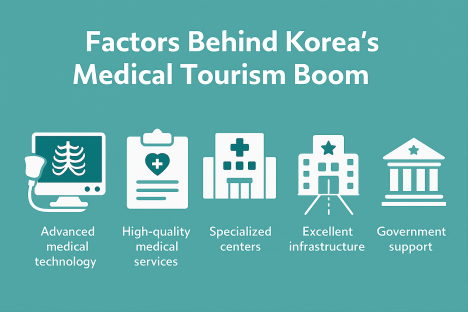
Factors Behind Korea’s Medical Tourism Boom
● Advanced medical technology: Korea is a global healthcare innovator in imaging, diagnostics, and robotics.
● High-quality medical services: Korean hospitals emphasize safety, ethics, and patient-centered care.
● Specialized centers: Leading medical institutions focus on cosmetic surgery, orthopedic, oncology, and cardiovascular care.
● Excellent infrastructure: Seoul and Incheon offer world-class airports, hotels, and transport links.
● Government support: The Ministry of Health and Welfare provides regulatory oversight and accreditation.
The medical tourism market in Korea thrives on synergy. It connects healthcare professionals, tourism organizations, and hospitality businesses under a shared initiative; the Medical Korea brand. Patients visiting South Korea often combine medical care with leisure activities.
KAMTOUR packages include cultural tours, recovery retreats, and concierge services. This integrated experience has redefined what it means to travel for health: a blend of state-of-the-art care and cultural immersion.
The Role of KHIDI: Policy, Quality, and Global Expansion
The Korea Health Industry Development Institute (KHIDI) is the backbone of Korean healthcare development. Established under the Ministry of Health and Welfare, it drives innovation, research, and international cooperation across the healthcare and medical tourism sector.
KHIDI’s Core Responsibilities
● Develop policies that strengthen Korea’s healthcare system and medical tourism industry.
● Evaluate and accredit hospitals serving foreign patients through standardized programs.
● Support international medical cooperation and overseas expansion of Korean hospitals.
● Collect data on medical tourist trends, wait times, and treatment outcomes.
● Promote Korea’s image through the Medical Korea brand.
KHIDI also connects medical institutions with global partners to exchange expertise and develop best practices. It supports Korea’s participation in the global healthcare industry, helping medical centers establish branches abroad, particularly in the UAE and Southeast Asia.
In 2024, KHIDI announced plans to strengthen digital medical services, integrate telemedicine for pre-consultations, and improve multilingual accessibility. These steps reflect Korea’s ambition to lead not just in medical care, but in healthcare diplomacy.
| KHIDI’s Key Initiatives | Purpose |
| Accreditation Program | Guarantee safety and quality for foreign patients |
| Medical Korea Brand | Promote Korean medical tourism internationally |
| Data & Research | Measure satisfaction, market trends, and outcomes |
| Overseas Expansion | Support Korean hospitals abroad |
| Training Programs | Educate medical tourism professionals |
Through KHIDI, Korea ensures that its medical institutions meet global healthcare standards while maintaining Korean medical excellence and patient trust.
The Role of KAMTOUR: Marketing and Experience Integration
While KHIDI focuses on standards and policy, KAMTOUR drives engagement, marketing, and coordination between patients and providers. Its mission is simple: make Korea the most accessible medical tourism destination in the world.
What KAMTOUR Does
● Connects international patients with accredited medical institutions.
● Designs integrated medical tourism services, from airport pickup to post-treatment care.
● Promotes medical tourism in Korea through trade fairs, digital campaigns, and partnerships with the Korea Tourism Organization
● Collaborates with hospitals, tourism organizations, and travel agencies to offer full recovery packages.

The Korean government has also empowered KAMTOUR to coordinate with global medical tourism associations, ensuring alignment with international patient care standards.
Its merges healthcare and hospitality, transforming the patient experience into a comprehensive journey that includes consultation, treatment, rehabilitation, and cultural engagement.
This “tourism marketing meets medical expertise” model is now studied by other leading medical tourism destinations.
| Phase | KAMTOUR Patient Support Activities |
| Pre-Travel | Online consultations, visa guidance, itinerary planning |
| During Stay | Hospital coordination, interpretation, local tours |
| Post-Procedure | Recovery lodging, follow-up care, travel arrangements |
Through KAMTOUR, medical travelers gain both confidence and comfort; knowing that every detail of their medical travel is managed with care.
The Korean Model: Integration Between Healthcare and Tourism
The success of medical tourism in Korea lies in its integration of healthcare and tourism infrastructure. Korean medical institutions work closely with hotels, translators, and transport services to create a seamless experience.
This cooperation ensures that international patients receive consistent care across touchpoints. From state-of-the-art hospitals in Seoul to rehabilitation resorts in Busan, Korea’s system of medical coordination provides safety, convenience, and hospitality.
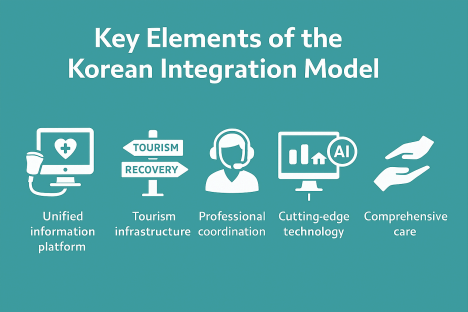
Key Elements of the Korean Integration Model
● Unified information platform: KHIDI’s Medical Korea portal centralizes hospital listings and service details.
● Tourism infrastructure: Korea Tourism Organization helps patients combine sightseeing with recovery.
● Professional coordination: Licensed medical tourism agencies arrange translation, accommodation, and logistics.
● Cutting-edge technology: Hospitals use digital records and AI scheduling for smoother coordination.
● Comprehensive care: From initial consultation to discharge, continuity is maintained through shared systems.
This integrated ecosystem demonstrates how Korean healthcare innovation goes beyond treatment; it’s a national collaboration that connects medicine, travel, and culture.
For many visitors, South Korea offers a unique balance: the comfort of hospitality and the trust of medical precision.
Korea’s Competitive Edge: Technology, Quality, and Service
South Korea’s healthcare industry competes globally on the strength of its excellent medical technology, qualified health providers, and state of the art facilities.
Technology-Driven Medicine
Korean hospitals lead in minimally invasive surgery, cancer therapies, and robotic systems. Centers like Samsung Medical Center and Severance Hospital represent world benchmarks in patient safety and research.
Quality and Standards
KHIDI’s accreditation ensures each medical institution provides consistent, quality medical care. Hospitals undergo regular evaluation for infection control, staff training, and ethical conduct.
Patient Experience
KAMTOUR enhances service standards by training staff in multilingual communication, cultural understanding, and concierge management.
Comparison Table: Korea vs. Other Destinations
| Feature | South Korea | Thailand | Singapore |
| Medical Technology | Cutting-edge and AI-based | Modern | High but costly |
| Wait Times | Very low | Moderate | Moderate |
| Accreditation | KHIDI & JCI | Mostly JCI | JCI |
| Focus Areas | Cosmetic, cancer, orthopedic | Wellness | Cardiovascular |
| Tourism Integration | Strong | High | Medium |
The combination of advanced medical expertise, short wait times, and high service quality makes Korea one of the world’s most attractive medical hubs.
Collaboration Between KAMTOUR, KHIDI, and Other Stakeholders
The success of Korea’s medical tourism sector relies on collaboration. KAMTOUR and KHIDI operate in synergy, supported by the Korean government, medical tourism professionals, and the Korea Tourism Organization.
Cross-Sector Collaboration
● Policy leadership: The Ministry of Health and Welfare defines regulation and quality metrics.
● Operational coordination: KHIDI ensures compliance, while KAMTOUR manages outreach and service delivery.
● Tourism integration: The Korea Tourism Organization links healthcare with travel experiences.
● Academic support: Universities and research centers study trends, patient outcomes, and market growth.
This structure forms a comprehensive ecosystem of healthcare, tourism, and policy; an example of how developed nations can structure health and medical care collaboration.
Joint initiatives, like Medical Korea Week and Global Healthcare Congress Seoul, showcase the country’s innovation to international patients and healthcare professionals worldwide.
Together, KHIDI and KAMTOUR ensure that Korea’s medical tourism industry continues to expand, adapt, and set standards for others to follow.
Challenges and Opportunities in the Next Decade
Despite strong growth, the medical tourism market faces challenges. Global competition is intensifying, and patient expectations are rising. Korea’s healthcare leaders recognize that maintaining trust and innovation requires continuous evolution.
Challenges Ahead
● Regulatory alignment: Balancing domestic policies with global healthcare standards.
● Workforce adaptation: Training more bilingual and culturally aware medical staff.
● Ethical marketing: Avoiding over-commercialization of health tourism.
● Post-pandemic travel: Managing safety protocols for international medical visitors.
Opportunities
● Digital healthcare expansion: Teleconsultations, remote monitoring, and AI diagnostics.
● Regional partnerships: Increased cooperation with Thailand, Japan, and the Middle East.
● Rising demand: More patients seek medical care abroad for specialized and affordable options.
● Global recognition: Korea’s healthcare system ranked among the best in global medical tourism indices.
With KHIDI’s initiatives and KAMTOUR’s marketing expertise, Korea is poised to shape the future of global healthcare in the next decade.
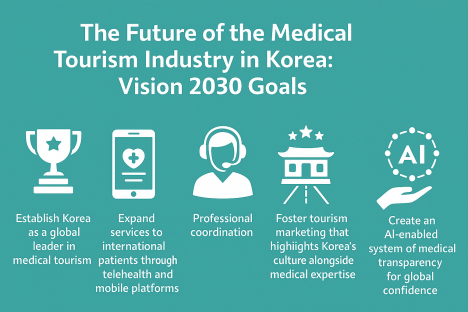
The Future of the Medical Tourism Industry in Korea
The next phase of Korean medical tourism focuses on sustainable growth, innovation, and inclusivity. Both KHIDI and KAMTOUR are advancing programs to make Korean healthcare accessible and patient-centered for a global audience.
Vision 2030 Goals
● Establish Korea as a global leader in medical tourism.
● Expand services to international patients through telehealth and mobile platforms.
● Promote specialized medical treatments in cancer, orthopedics, and regenerative medicine.
● Foster tourism marketing that highlights Korea’s culture alongside medical expertise.
● Create an AI enabled system of medical transparency for global confidence.
The Korean government has also emphasized sustainability, ethical care, and digital transformation as cornerstones of this new era.
Through coordinated initiatives, Korea continues to redefine what a destination for medical excellence means; offering not just treatment, but holistic well-being.
Conclusion
The partnership of KAMTOUR and KHIDI represents the synergy of policy, technology, and hospitality. Their collaboration has turned South Korea’s healthcare industry into a global healthcare model; one that blends quality medical services, and cultural empathy.
Korea’s medical tourism industry is now among the world’s fastest growing, supported by government, institutional collaboration, and innovation. From cosmetic surgery to complex medical procedures, Korea continues to set standards that influence global health trends.
In the future of the medical tourism market, South Korea is not just participating; it is leading. With cutting edge technology, top healthcare professionals, and tourism infrastructure, Korea shows how a nation’s healthcare system can become a bridge between medicine and culture.
For patients worldwide, Korea offers not only healing but trust; a new vision for global healthcare shaped by the partnership of KAMTOUR and KHIDI.

