
In the last decade, medical tourism in South Korea has transformed from a niche market into a thriving medical tourism industry recognized across the world.
Once known almost exclusively as the plastic surgery capital and the “surgery capital of the world,” Korea has since diversified into a hub for advanced medical treatment, medical procedures, and integrated healthcare services for foreign patients.
For Americans, the appeal is clear. Korean medical institutions are equipped with advanced medical facilities, cutting-edge imaging such as MRI, globally competitive surgical suites for orthopedic surgery, cancer treatment, and even organ transplant programs.
At the same time, the Korean government, through the Ministry of Health and Welfare, has created robust policies to attract foreign patients by ensuring accreditation standards, patient safety protocols, and services for international patients.
If you’re considering traveling to Korea for medical care, this guide will walk you end-to-end; from initial planning, selecting a hospital, coordinating with Korean doctors and medical staff, getting treatment, to recovery and returning home.
Why South Korea Is a Global Medical Tourism Leader
Since the last couple of years, Korea is experiencing a huge rise in Medical Tourism. Here’s why Americans tend to visit Korea for medical procedures.
A surge in international patient flows
In 2024 alone, approximately 1.17 million foreign patients from 202 countries visited Korea for medical services, making it one of the most active global medical travel destinations.
Among them, the United States contributed 101,733 patients; which is a sizable share, showing the strength of Korea’s pull for American patients.
Government data from 2023 show that over 600,000 foreign patients visited Korea, the highest annual number since tracking began in 2009.
This cumulative growth underscores the country’s capacity, reputation, and international trust as a medical destination.
Korea’s healthcare reputation
The Korean healthcare system has consistently received global recognition. Beyond its dominance in cosmetic surgery, Korean hospitals and Korean clinics have built reputations in cardiology, oncology, orthopedic care, and minimally invasive robotic surgery.
Many Korean medical facilities are tied to major universities, ensuring that patients are treated by highly trained healthcare professionals engaged in both clinical care and cutting-edge research.
Scale of the medical tourism business
In recent years, more than a million foreign patients have made medical visits to South Korea annually. The medical tourism business has been growing steadily, with the U.S. consistently ranking among the top countries sending medical tourists to Korea.
South Korean medical tourism thrives because it combines advanced medical offerings with Korea’s reputation as a safe, modern destination supported by Korea tourism organization infrastructure.
Korean government support
The welfare of South Korea includes a strong commitment to healthcare.
Through the Ministry of Health and Welfare and KHIDI’s Medical Korea platform, policies are in place to ensure patient rights, resolve medical disputes, and promote accreditation programs for hospitals serving foreign patients.
This program for hospitals serving foreign patients evaluates both infection control and quality of services for international patients, ensuring credibility for Americans coming to Korea for care.

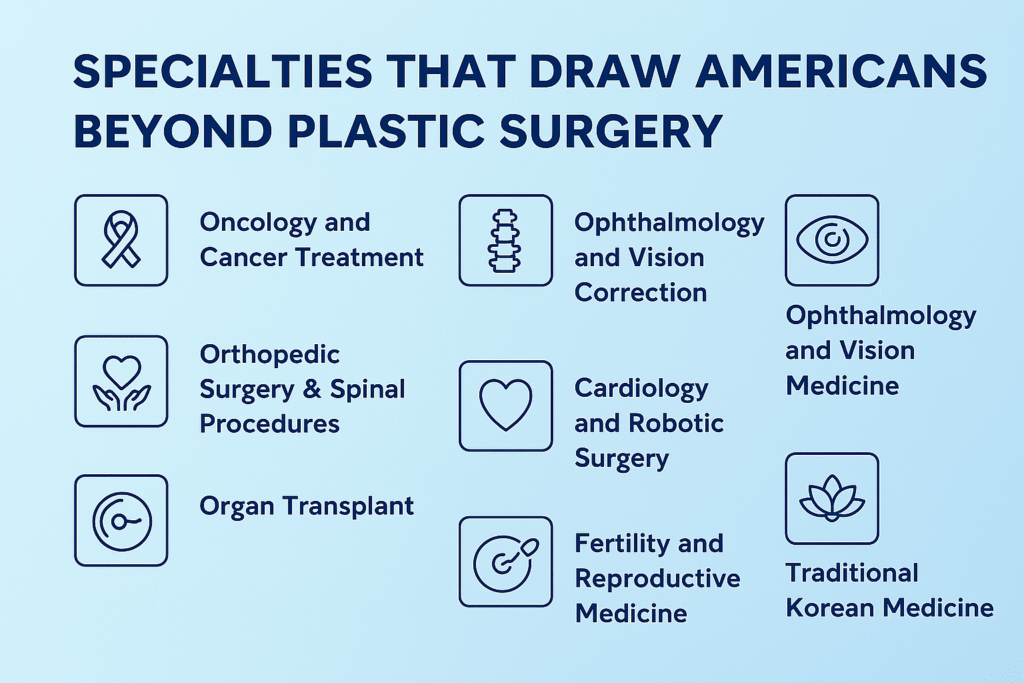
Specialties That Draw Americans Beyond Plastic Surgery
While plastic surgery remains one of the best-known services, the reality of Korean medical tourism is far broader. U.S. patients now travel for:
Oncology and Cancer Treatment:
Leading Korean hospitals provide integrated cancer centers with advanced chemotherapy, radiotherapy, and surgical oncology. Patients benefit from stem cell therapy research and precision medicine.
Orthopedic Surgery & Spinal Procedures:
Korea has developed strong programs for orthopedic surgery, spinal fusion, minimally invasive spine interventions, and joint replacement using minimally invasive techniques. Rehabilitation programs integrate physiotherapy with modern technology.
Ophthalmology and Vision Correction:
LASIK, SMILE, cataract surgery, and premium intraocular lens implants are frequently chosen by medical tourists. Korean centers have some of the highest procedure volumes worldwide.
Cardiology and Robotic Surgery:
From bypass surgery to robotic surgery in urology and cardiology, Korea is on the frontier of minimally invasive approaches.
Organ Transplant:
Some Korean medical institutions have world-renowned organ transplant programs for liver, kidney, and stem cell transplants.
Fertility and Reproductive Medicine:
IVF and assisted reproductive technologies attract many Western couples.
Traditional Korean Medicine:
Many foreign patients integrate traditional Korean medicine into recovery packages, blending herbal, acupuncture, and holistic methods with western interventions.
Accreditation, Safety & Quality Infrastructure
No matter where you travel for healthcare, verifying quality is essential. Korea has put in place robust accreditation and oversight mechanisms specifically tailored for foreign patients.
KAHF: Korean Accreditation Program for Hospitals Serving Foreign Patients
KAHF is Korea’s official accreditation geared toward institutions that treat international patients. It evaluates both foreign patient services (interpretation, medical dispute systems, patient rights, etc.) and patient safety systems (infection control, medication management, facility standards).
Hospitals that earn KAHF designation can display the logo and are seen as more trustworthy by foreign patients. The program has operated in cycles since 2016 and is currently in its 4th cycle.
KAHF grants tangible advantages: domestic/international promotion, eligibility for government incentives, and preferential positioning for being designated as a medical tourism “excellent institution.”
Other quality and safety indicators
- Many top hospitals in Korea also hold JCI (Joint Commission International) or ISO certifications, which are additional credibility markers.
- Hospitals with strong reputations, research presence, and academic affiliations tend to have more rigorous oversight and systems.
- The Korea Health Industry Development Institute (KHIDI) underpins many of these regulatory and promotional frameworks. KHIDI promotes foreign patient protection, convenience, and global healthcare outreach.
- The Medical Korea portal is run through KHIDI and serves as an official gateway for foreign patients to find accredited institutions, services, and regulatory info.
For American patients, using these accreditation and registration systems as filters is a key first step in safe planning.
Planning Your Trip: Strategy & Pre-Travel Steps
A successful medical tourism trip starts long before boarding the plane. Planning well can reduce stress, improve outcomes, and ensure continuity with your U.S. care team.
Researching procedures and hospitals
Start by browsing Medical Korea / KHIDI listings of registered foreign patient hospitals and KAHF-accredited centers.
Narrow by specialty, hospital reputation, published procedural volumes, and experience with international patients.
Communication & quotes
Reach out to hospitals’ International Patient Centers (many have dedicated teams). Request a preliminary treatment plan, expected steps, required diagnostics, and clarifications about inclusions (tests, anesthesia, room, follow-ups).
Ask for these in writing in English. Don’t focus primarily on price comparisons; rather ensure transparency, what is included, and how follow up will work.
Gather your medical records
Collect recent imaging, lab results, pathology reports, medication lists, physician summaries, and any relevant history. Translate (or request translation) of key reports into English or Korean.
Insurance and risk planning
Check your health insurance: some U.S. insurers may reimburse or cover complications abroad under certain policies.
Consider supplemental travel medical and evacuation coverage. Ensure you have a plan if complications arise during or after treatment.
Pre-travel telemedicine / consultation
Many Korean hospitals offer remote consultations prior to travel. This allows for early review of your case, planning of diagnostic steps, and smoother admission once you arrive.

Travel & Logistics: Reaching Korea & On Arrival
Getting from the U.S. to Korea and managing your stay requires attention to both medical and travel details.
Visa and entry requirements
International patients often use medical visas or special entry pathways. Check with Korean embassies or via Medical Korea portals for the up-to-date visa policies. (Medical Korea publishes foreign patient entry guidance in its notices.)
Flights & routing
There are direct and one-stop flights from major U.S. cities to Seoul (Incheon International Airport). Ensure your flight arrangements allow for rest and buffer time for initial appointments.
Airport and ground support
Some hospitals or medical tourism facilitators arrange airport pick-up, fast-track services, or meet-and-greet support.
Incheon Airport has infrastructure and services tailored to international travelers (e.g. signage, multilingual support).
Accommodation and proximity
Many patients stay in medical tourism hotels or stay near hospital districts. Choosing lodging close to the hospital helps reduce travel stress during recovery. Some hospitals have affiliate recovery or patient guesthouses.
The Patient Journey in Korea
Once you have landed on the ground, your care path in South Korea typically follows these stages:
Initial arrival & orientation
You meet your international patient coordinator, interpreter, and receive orientation on hospital procedures, consent, safety protocols and schedule.
Your first in-person consultation revisits the medical plan, examines diagnostic inputs, and finalizes the treatment strategy.
Pre-treatment workup
You may undergo imaging, lab tests, specialized diagnostics (e.g. MRI, PET, cardiology workups) or pre-op evaluations. If tests are done externally or earlier, those are reviewed.
Procedure / treatment phase
Depending on your procedure, this might be surgery, interventional therapy, radiation, or other specialty treatment.
Hospitals typically follow standard safety, anesthesia, and post-op protocols. For less invasive procedures (e.g. ophthalmology, dermatology, checkups) you may even have day visits.
Hospital stay and monitoring
You’ll be hospitalized for the required duration (overnight, multi-day, or longer for complex cases).
Post-operative care includes pain management, wound monitoring, medication, physical therapy, and early rehab if needed.
International patient coordinators help facilitate follow up, interpreter services, and coordinate with your U.S. physician if requested.
Discharge & planning follow up
Before leaving, you’ll receive a care plan, prescriptions, and instructions for follow-up visits or telemedicine. If you’re returning to the U.S., arrange for local follow up or handover to your U.S. physician.
Recovery, Rehabilitation & Return to the U.S.
A critical phase is how well your healing proceeds once you depart Korea. Length of stay in Korea depends on procedure complexity.
Recovery programs and rehabilitation
Many hospitals and recovery guesthouses offer rehabilitation, physiotherapy, occupational therapy, and nursing support.
For orthopedic, spine, cardiac or neurological cases, in-hospital or outpatient rehab is often part of the service offering. Some patients stay extra days purely for recovery and light monitoring before long flights.
Telemedicine follow-up
Korean hospitals increasingly provide telemedicine follow-up services. You can stay in touch with your treating team, share reports, photos, and have periodic check-ins remotely. Such remote continuity helps ensure safety once you’re home.
Medication and continuity of care
Confirm prescriptions, drug availability, substitution, and how to access refills in the U.S. Share your Korean medical summary and discharge documentation with your U.S. physician, and coordinate any further treatment transitions.
Light travel and recuperation tourism
If your condition allows, you can integrate light recovery tourism: visiting calm destinations (Jeju, Busan, cultural districts in Seoul).
Always abide by your doctor’s movement / activity restrictions, prioritize rest and avoid overexertion.
Choosing the Right Hospital: Checklist & Red Flags
To maximize your safety and outcomes, here’s a practical checklist. By carefully vetting these criteria, you reduce the risk of surprises later.
Essential criteria
- KAHF accreditation or registration: Hospitals accredited under the KAHF program are officially evaluated for foreign patient safety and services.
- International patient center / coordinator: A dedicated team to assist with logistics, translation, admissions, follow up.
- Published credentials and specialty track record: Surgeon caseloads, subspecialty designations, outcomes, research presence.
- English / multilingual support: Senior staff or interpreters fluent in English, documentation in English.
- Continuity and telemedicine support: Capability for remote follow-up after you return home.
- Transparent diagnostic & treatment plans: Formal written plan, breakdown of tests, timing, and what is included.
- Safety systems and infrastructure: Clean facilities, infection control, ICU capabilities, emergency protocols.
Red flags to avoid
- Institutions that are not found in Medical Korea or KHIDI foreign patient registry.
- Clinics unable or unwilling to show a Certificate of Registration for foreign patient attraction. Because this is an official government certificate for registered foreign patient institutions.
- No interpreter or coordinator support offered.
- Lack of clarity about follow-up care or discharge planning.
- No published credentials or vague claims without substantiation.
Patient Rights, Safety, and Dispute Handling
Even in top medical systems, risks exist. It’s crucial to know your rights and how to navigate complications.
Rights protection & oversight
- Hospitals accredited via KAHF are required to have systems for foreign patient dispute resolution and safeguards for rights.
- Medical Korea’s Information Center provides consulting services for foreign patients, basic help in medical accidents, and a route to register disputes.
- KHIDI supports initiatives to protect foreign patient rights and enhance convenience in using Korean medical services.
Safety considerations
- Insist on informed consent documentation in English that explains risks, alternative options, possible complications, and anticipated recovery.
- Ask about infection control, surgical protocols, emergency backup, and post-op monitoring plans.
- Ensure you have a plan for unexpected events (e.g. complications requiring extended hospitalization or alternate care) and verify how those would be handled logistically and financially.
Dispute handling & appeals
- If issues arise, KAHF-accredited hospitals are supposed to have internal patient complaint systems.
- For unresolved disputes, leverage the Medical Korea / KHIDI support lines or foreign patient centers.
- Keep all medical records, imaging, correspondence, and receipts; these are your basis for any claims or recourse.

Sample Timeline & Itinerary for a U.S. Patient
Here’s a hypothetical 10-day timeline for a patient traveling to Korea for a mid-complexity procedure (e.g. orthopedic or cardiology):
| Day | Activity |
| Day 1 | Arrival, rest, orientation & meeting coordinator |
| Day 2 | Diagnostic work-up (imaging, labs, specialist consultation) |
| Day 3 | Further evaluations, finalize procedure plan, pre-op preparation |
| Day 4 | Procedure / surgery |
| Day 5 | Inpatient recovery & monitoring |
| Day 6 | Early mobilization / therapy, initial discharge planning |
| Day 7 | Rehabilitation / outpatient therapy + final checks |
| Day 8 | Telemedicine check-in, prepare discharge documentation |
| Day 9 | Buffer day (for any delayed follow-up or minor issues) |
| Day 10 | Return travel to U.S. with discharge summary and medications |
Longer or more complex care cases (e.g. oncology, transplant) may require multi-week stays, staged treatment, or multiple visits over months.
Integrating Recovery & Visiting Korea
A benefit of medical tourism is combining recuperation with mild tourism; when allowed by your medical team.
- Seoul & nearby cultural sites: If based in Seoul, visiting palaces, riverside parks, gentle neighborhood walks (e.g. Bukchon, Insadong) can be soothing.
- Jeju Island: If your condition permits, Jeju offers calm natural settings, sea views, and mild-air environments ideal for gentle recovery.
- Busan: A coastal city with relaxed beaches and seaside walks (if mobility allows).
- Hospital vicinity rest: Many hospitals are located near parks or green spaces — great for short, restful strolls.
Always confirm with your treating physician before venturing out. Don’t overextend; prioritize rest and avoid strenuous travel until cleared.
Challenges and Considerations
As you visit South Korea for medical checkups and tourism altogether, you need to stay informed about these challenges and considerations.
Language & cultural barriers
While many international patient centers provide interpreters, subtleties in communication (nuances, medical preferences) may be lost. Patients should ask clarifying questions, repeat back instructions, and ensure consent documents are well understood.
Length of stay unpredictability
Some complications or slower-than-expected recovery may extend your stay. Build buffer days into your travel schedule and flexible airfare options.
Medication differences
Korean formulations or brand names may differ from U.S. versions. Confirm equivalence, ensure prescriptions are portable, and whether refills can be accessed in your home country.
Follow-up continuity
Failure to set up good post-treatment care back home is a major risk. Ensure your U.S. physician is involved in the handover.
Insurance & financial ambiguity
Not all U.S. insurers cover care abroad. Some clinics may quote lump sums but exclude potential complication costs. Ask for clarity and written exception policies.
Integrating Healthcare With Korea Tourism
Korea tourism organizations often collaborates with hospitals to design tour packages for light sightseeing. Popular choices include Seoul’s palaces, Busan’s beaches, or Jeju Island wellness retreats.
This blending of Korean tourism with Korean medical tourism creates a holistic experience. Americans can return home with not just restored health but enriched cultural memories.
Future of Korean Medical Tourism
With ongoing investment, South Korean medical tourism continues to expand. Areas of growth include:
- Stem cell therapy
- AI-driven diagnostics
- Expanded medical tourism business collaborations with Korea tourism organization
- Integration of traditional Korean medicine with modern healthcare services
The health and welfare of South Korea are linked directly to sustaining this global healthcare leadership role.
Conclusion
For Americans, medical tourism in South Korea represents a unique opportunity.
Whether traveling to Seoul for a medical checkup, undergoing orthopedic surgery, or seeking cancer treatment, patients benefit from Korean hospitals, advanced medical procedures, and accredited medical facilities.
By choosing accredited medical institutions, coordinating with international offices of Medical Korea, and planning carefully for medical visits, U.S. patients can safely access one of the most advanced healthcare systems outside the western countries.
South Korea is no longer just the plastic surgery capital. It is a mature medical tourism industry destination; equipped for oncology, orthopedic surgery, organ transplant, robotic surgery, and much more.
As more Americans explore Korean medical tourism, Korea’s reputation as a top medical hub will only strengthen.

